The Six Realms of Transmigration can be defined as the essence of Buddhist philosophy in regards to reincarnation and the cycle of life. The Wheel of Life, or Bhavachakra, depicts and explains the cyclical nature of reincarnation, along with the multiple aspects of our perceived reality as normal beings. The six realms also show the importance of our actions and how they can dictate the results of our existence – this is the essential point in Buddhism called Karma.
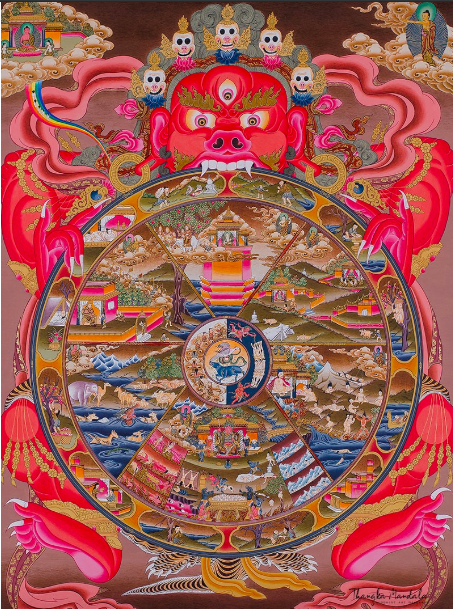
The Wheel of Life is driven by the inner circle, which is powered by three animals that represent the three poisons in life: greed, hatred, and ignorance. The rooster represents greed, the snake represents hatred, and the pig represents ignorance. These three poisons trap us in the wheel of life, and the goal is to escape from this infinite cycle of reincarnation and ultimately reach nirvana.
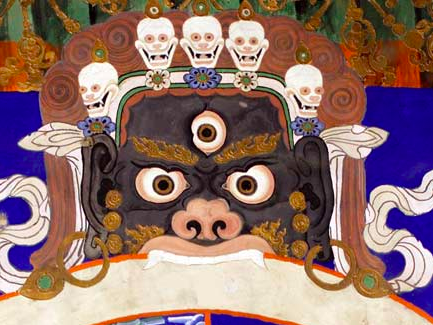
YAMA
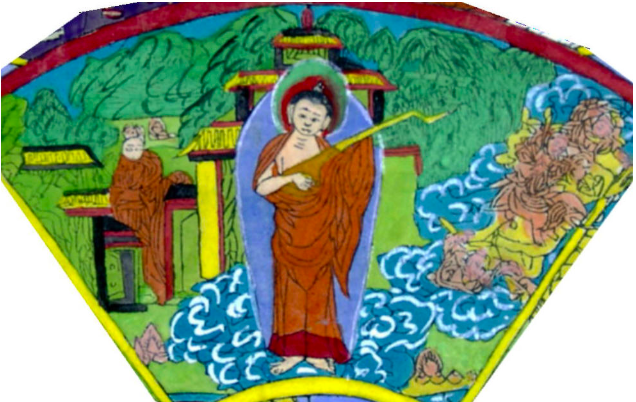
THE GOD REALMS
THE HELL REALMS
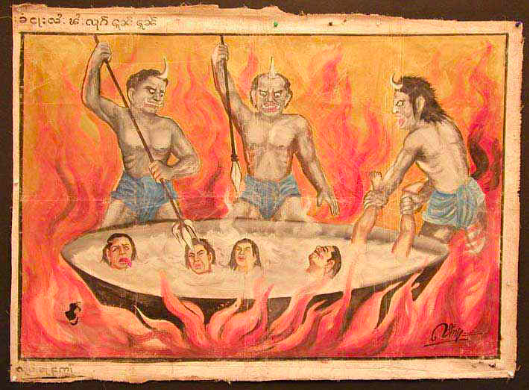
Within the Hell realms, the punishments given to the convicted sinners are usually quite specific to the crime they committed, which is ultimately done to show the power and influence that karma has on our existence. The Nakara Section of The Realms of Rebirth reads:
"Those who kill (creatures) born in water, such as fish, go to the terrible river Vetarani whose running water is like blazing copper; (there) one is consumed by fire for a long time" (35).
While there are many heavens and hells with eternal lasting punishments, nothing is permanent. The Wheel of Life is strict, but fluid, and beings can get in and out of any realm to enter a new realm or eventually reach nirvana. Leaving the hells of the wheel does not guarantee an escape from the bad karma that was accumulated in a past rebirth. This is shown in the story of Isidasi within the Therigatha text which reads:
"When I died, I cooked in hell for a long time, and then rising from there, I entered the womb of a monkey. A great monkey, the leader of the troop, castrated me when I was seven days old, this was the karmic fruit for the adultery" (439).
The Six Realms of Transmigration represent all the possible states of existence in Buddhist philosophy. While originally they were perceived as real places, they can all be interpreted as symbolic locations of the mental state of reincarnation. Karma dictates birth within any of the states, as virtuous actions lead to good karma and rebirth into the realms of the gods, and bad actions lead to bad karma and rebirth into the realms of hell. The realms are not permanent and there is a chance within all of them to exit and enter at any given time. Moving from one realm to another does not guaranteed the cleanse from bad karma, as it can always greatly impact the future rebirths in a negative way.
REFRENCES
- “Turning of the Wheel:” Bhavacakra, www.lib.uidaho.edu/digital/turning/Bhavacakra.html.
- O’Brien, Barbara. “The Wheel of Life in Tibetan Buddhism.” Learn Religions, Learn Religions, 22 Dec. 2018, www.learnreligions.com/the-wheel-of-life-4123213.
- “The Buddhist Wheel of Life Explained Step by Step.” Tours to Ladakh India Bhutan Central Asia, www.gesar-travel.com/wheel-of-life/?lang=en.
- “Religion & Ethics – In Pictures: Buddhist Wheel of Life.” BBC, BBC, www.bbc.co.uk/religion/galleries/bhavachakra/.
- “Isidasi.” Therigatha: Poems of the First Buddhist Women, by Charles Hallisey, Harvard University Press, 2015, p. 205.
FURTHER READINGS
- https://wesmoodle.wesleyan.edu/pluginfile.php/436617/mod_resource/content/1/Realms%20of%20Rebirth%20-%20Buddhist%20Scriptures%203-18%20.pdf (This is an informative text on the realms of rebirth. The reading offers an in depth look into the punishments that are granted to the convicted sinners within the Hell realms).
- https://www.thangka-mandala.com/blog/the-wheel-of-life/ (This text is useful for its description of the impact karma has within our existence in the six realms of transmigration. There is also a detailed breakdown of the sections of the Wheel of Life that does a good job of explaining what goes on within the realms through color imagery).
- https://personal.carthage.edu/jlochtefeld/buddhism/wheeloflife/sixrealms.html (This link leads to a site that explains the actions that lead to the entry of each of the realms. There are also pictures with descriptions to give the reader a clear view of the realms through the perception of a follower of Buddhism).
EXTERNAL LINKS
- https://www.britannica.com/topic/Buddhism (This link leads to an encyclopedia that covers the main idea of Buddhism by looking at it on a larger scale. Some of the sections that the text touches include the history, multiple paths of beliefs, celestial background, cultural context, and much more).
- http://www.buddhism-dict.net/ddb/ (This is a digital dictionary of Buddhist terms and practices that is good for clarification on a large variety of Buddhist vocabulary.)
- https://www.youtube.com/watch?v=9MYyqv6d_DE (This is an informative video that covers the importance of each realm through animated imagery. The process of traveling from realm to realm is also explained.)


This was a very straightforward and approachable entry on the Six Realms of Transmigration! I really liked how you started with a broader overview (and an image of the entire Wheel of Life) and then moved more specifically into the different higher and lower realms. I also really enjoyed the images that you chose and thought they did a good job in illustrating the stark contrast between the god realms and the hell realms. The only constructive comment I can think of would be perhaps to elaborate slightly more on the realms within the god and hell realms and the distinctions–for instance distinguishing between the god realm and demi-god realm. I think your discussion of how karma is involved with the Six Realms was really thorough yet succinct and you did an excellent job underscoring the aspect of impermanence in all of the Six Realms.
I thought this was a well-structured and digestible definition of the term — it was easy to follow and flowed nicely. Your explanations were clear and I thought your break down of the specifics of the term made it feel less complicated. I also liked how you organized it so the initial image of the entire wheel went with the general explanation and the more targeted explanations were put with the images of smaller sections. The only thing I would suggest is maybe adding some more information about samsara and nirvana in relation to the six realms because I think it would provide the reader with some broader context. But overall it was well-written and easy to understand !
Nice histories, characters and performs.
This is a wonderfully insightful post on the Six Realms of Transmigration! I truly appreciate how you broke down the complex concepts of the Wheel of Life and Karma into such an understandable format. The explanation of the three poisons and Yama’s role adds so much depth. It really makes one reflect on the importance of our actions. I’m always looking for resources that help simplify these profound philosophical ideas, and this post does an excellent job. It reminds me how valuable clear, concise information can be, much like a reliable tool simplifies complex tasks, such as a BA II Plus Financial Calculator can simplify financial calculations. I’m looking forward to reading the rest of your insights!
This is a wonderfully clear and concise explanation of the Six Realms of Transmigration and the Wheel of Life. I particularly appreciated the breakdown of the three poisons – greed, hatred, and ignorance – and how they drive the cycle. Understanding Yama’s role as a protector of Buddhist ideals, rather than an evil figure, was also very insightful. Thanks for shedding light on these profound concepts; it’s exactly the kind of valuable content I look for on sites like Block Poster.
This is a fantastic and concise explanation of the Six Realms of Transmigration and the Wheel of Life. I particularly appreciate how you broke down the “three poisons” and the role of Yama. Understanding these core concepts is crucial for grasping Buddhist philosophy, and your article makes them very accessible. It’s truly eye-opening to consider how our actions define our existence, and reaching nirvana is the ultimate goal. For those interested in visualizing such complex ideas, a tool like AI Image to Line Converter could even help in creating illustrative diagrams!
This is a fascinating and well-explained summary of the Six Realms and the Wheel of Life! The way you break down the three poisons and link them to our actions and Karma makes these complex concepts really accessible. It’s thought-provoking to consider how our choices shape our existence within these realms. Thanks for sharing this insightful piece – it certainly gives one pause to reflect on the meaning of life. It makes me wonder about the vastness and precision of different systems, almost like how we might need a precise Square Feet Calculator for specific measurements.